
City guides Miami, FL
Miami · scene guideMiami for collaborators.
Miami is the Latin music industry's capital and a dance-music capital at the same time, with a rap lineage running from Liberty City to Carol City underneath both. The metro is long and flat, so the Wynwood band crowd, the South Beach DJ economy and the Miami Gardens rap producers can go months without meeting. What connects them is a small circle of engineers and shooters who work all three.
Where the work happens.
- 01
Wynwood and Allapattah
Wynwood is the indie and art-crowd hang: Gramps has been the neighborhood bar-venue for years, III Points turns the district into a festival every fall, and the warehouses spilling west into Allapattah hold project studios, rehearsal spaces and the occasional unlisted party.
- 02
Little Haiti and Little River
North of Wynwood the rents drop and the working layer thickens. Sweat Records anchors the record-store and show-flyer economy, the Little Haiti Cultural Complex stages konpa and Caribbean nights, and Little River's warehouses have become a second studio and rehearsal district. Producers with a bedroom rig and a mic often land here first.
- 03
Little Havana
Calle Ocho is live Latin music seven nights a week. Ball and Chain books salsa, son and Latin jazz on a historic corner, the bars around Domino Park keep trios and conjuntos working, and this is where percussionists, horn players and salsa singers find each other.
- 04
South Beach and Downtown
The Beach is the DJ and club economy: the big rooms along Collins and Washington, the smaller house and techno spots that outlast the tourist rotation, and Miami Music Week every March, when the whole electronic industry lands at once. Downtown, Club Space runs its terrace past sunrise, Bayfront Park hosts Ultra, and Brickell holds the Latin label offices where A&R meetings get scheduled.
- 05
North Miami, Miami Gardens and Hialeah
The trophy studios are north: Criteria in North Miami has tracked hits since the fifties, and Circle House nearby has been a rap and reggae room for decades. Miami Gardens and Carol City are the rap heartland, home turf for Rick Ross and Denzel Curry, with 99 Jamz breaking the records. Hialeah holds a dense layer of Latin home studios and rehearsal rooms.
Rooms
Where it gets recordedCriteria and Circle House sit at the top, booked through managers, producers and the Latin labels weeks ahead with engineers billed on top. The middle is warehouse project rooms across Wynwood, Little River, Allapattah and Doral that confirm by text or DM and usually include an engineer for vocal and mix work. The biggest layer is home studios across Hialeah, Kendall, Miami Gardens and up into Broward, where most of the city's rap, reggaeton and Latin pop demos actually get made, booked by referral and Instagram DM. Walk-ins do not exist; somebody vouches for you first.
Nights
Where collaborators meetElectronic producers and DJs meet at Space's terrace and the smaller house rooms on the Beach, and Miami Music Week compresses a year of introductions into seven days. Rap and R&B move through the club DJ circuit, Rolling Loud's hometown edition at Hard Rock Stadium in Miami Gardens, and 99 Jamz spins. Latin players find each other on Calle Ocho and at the konpa and Caribbean nights in Little Haiti. Bands and songwriters gather at Gramps, Sweat Records in-stores and the III Points weekend, and the Frost School at the University of Miami feeds a steady bench of players into everything.
How it books
Sessions, features, shoots, showsLatin sessions get booked the industry way: a label or publisher A&R in Brickell pairs a producer and an artist, and the room in North Miami or Hialeah gets locked through the producer. Rap and R&B features move through DMs and club co-signs, often cut in a Miami Gardens or Broward home studio the same night. Electronic collaborations start on a dance floor or a festival lineup and turn into a remix by text. Shoots lean on the city's look, and crew work on the Beach or downtown needs permits. Shows book through the Beach club promoters, the Wynwood venues that take direct pitches, and the Latin promoters who run the arena and theater bills.
What Miami is known for.
Hip-hop
Miami rap runs on a Carol City and Liberty City lineage: Uncle Luke and 2 Live Crew set the bass template, Trick Daddy and Trina made Slip-N-Slide the hometown label, and Rick Ross and Denzel Curry carried Miami Gardens onto national charts. 99 Jamz still breaks the records, the club DJ circuit still decides which ones run, and the next class is cutting in home studios from Opa-locka up into Broward County.
How Hip-hop collabs get madeR&B
R&B here has always ridden the bass line, from Pretty Ricky's Miami Gardens harmonies to the current run of singers cutting hooks over trap and reggaeton drums in the same rooms as the rappers. Circle House in North Miami has been a vocal room for decades, and the city's session singers work English and Spanish dates in the same week, which gives Miami R&B a bilingual reflex most cities do not have.
How R&B collabs get madePop
Pop in Miami is a bilingual business. Pitbull, Enrique Iglesias and Camila Cabello all came up here, and the Latin labels headquartered in Brickell and downtown run pop A&R in both languages out of the same offices. Songs get written in Hialeah and Kendall home rooms, cut at Criteria or the warehouse studios in Doral and Little River, and tested on the Beach before radio hears them.
How Pop collabs get madeIndie
Miami indie is small and stubborn. Gramps in Wynwood is the clubhouse, Sweat Records in Little Haiti is the notice board, and III Points is the annual proof that the scene exists at festival scale. Bands here share drummers, borrow vans and play the same handful of rooms until one of them tours north, and the Frost School keeps feeding players who can handle indie, jazz and Latin sessions in the same week.
Electronic
Two institutions define the scene: Ultra at Bayfront Park every March, with Miami Music Week filling the Beach's clubs around it, and Club Space, whose terrace has run past sunrise since the turn of the century. Between them sit the smaller house and techno rooms on the Beach and the warehouse parties in Allapattah and Little River, plus III Points each fall, where the local DJ bench meets the touring end.
How Electronic collabs get madeLatin
Miami is where the Latin music industry lives. Sony Music Latin, Universal Music Latin and Warner Music Latina operate out of the metro, Billboard's Latin Music Week lands here, and the Spanish-language radio and TV networks run their studios and stages across the city. Little Havana's Calle Ocho keeps the live tradition going nightly at rooms like Ball and Chain, while reggaeton and Latin trap get built in Hialeah and Doral studios and broken on the Beach.
How Latin collabs get madeHow the app works in Miami.
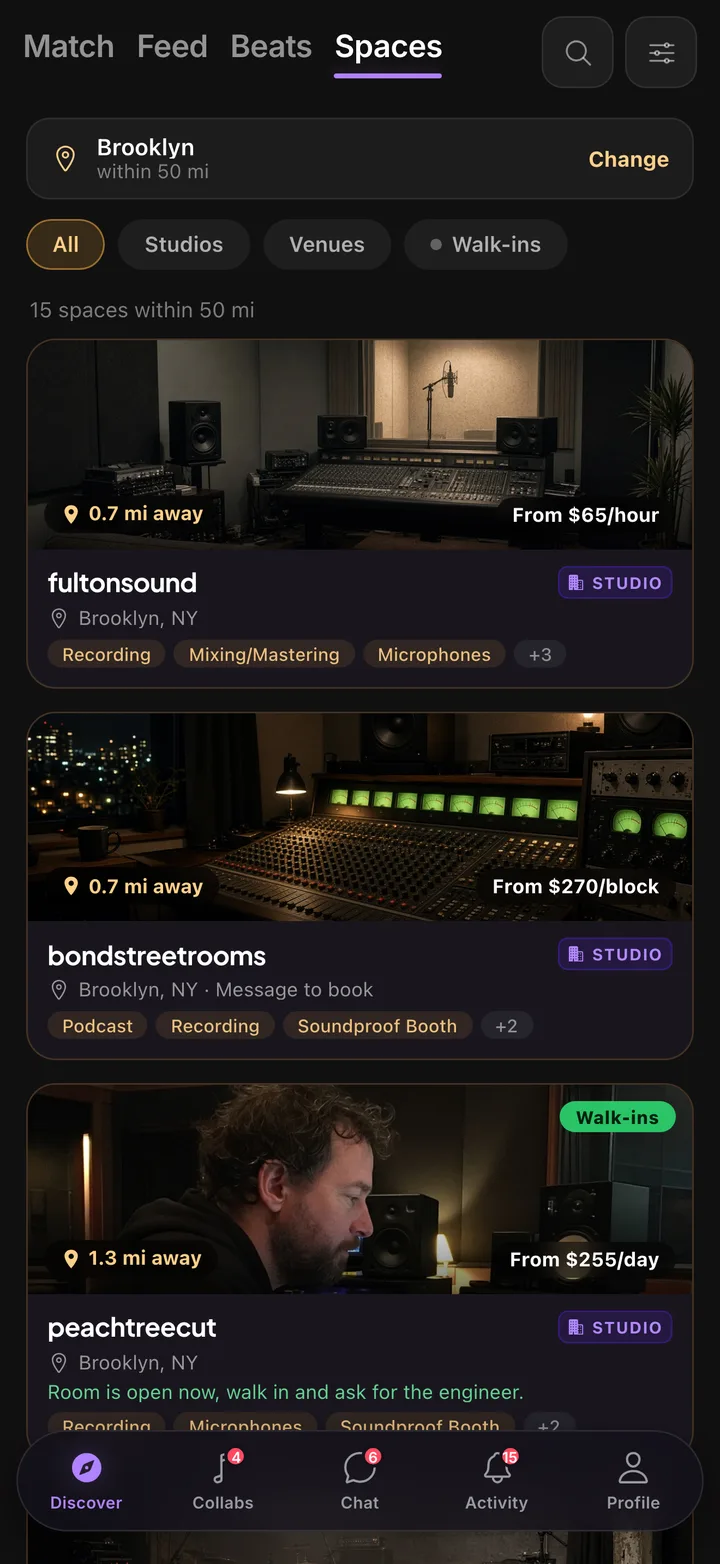
Local is a 50-mile radius around your location. The Feed filter and the Spaces search both start there, and the Match deck ranks by distance without fencing you in. When the room or the person you need is further out, widen Spaces to 100 or 250 miles or sort the deck by Best fit instead of Nearest.
What to look for here
- Producers within 40 miles who list reggaeton, Latin pop, trap or house and work out of a Hialeah or Little River studio
- Percussionists, horn players and salsa or Latin jazz singers near Little Havana
- DJs and electronic producers around Miami Beach and downtown looking for remix and vocal features
- Videographers and photographers in Miami with festival, club and rollout work on the reel
Studios and venues are found in Spaces and receive requests; they are never in the swipe deck. The rate and the terms get agreed in the app and settle between the two of you. KollabMe never holds the money.
Other cities.
Find the people near you.
Free to join. Setting up a profile takes about a minute.