
City guides Chicago, IL
Chicago · scene guideChicago for collaborators.
Chicago is a city of institutions and neighborhoods, and the working scene runs through both. House and footwork, the AACM and the Green Mill, the all-ages DIY circuit that keeps sending teenage bands to Matador: each one is a room or a night you can walk into. Bookers trade notes, engineers come included in the hourly rate, and a strong Tuesday at a small room travels fast.
Where the work happens.
- 01
Wicker Park and Ukrainian Village
The Empty Bottle on Western Avenue anchors Ukrainian Village any night of the week and is still where new bands play their first real show. Wicker Park holds the practice spaces and the bars where bands and producers overlap.
- 02
Logan Square, Avondale and Portage Park
The studio belt. Electrical Audio in Avondale still tracks bands to tape, Fort Knox in Portage Park stacks more than a hundred rehearsal and production suites into one complex, and Constellation on Western Avenue programs improvised music most nights.
- 03
Pilsen and Little Village
Thalia Hall in Pilsen is where the breakout show happens when a band's wave crests, and the neighborhood's galleries and bars host smaller bills most weekends. Little Village next door is the regional Mexican economy: quinceañera bands, corrido acts and DJs working year-round, with La Ley 107.9 on the radio.
- 04
Bridgeport and the South Side
The Ramova Theatre in Bridgeport gives soul, alt-R&B and hip-hop bills a big South Side home. Further south, the church circuit, Chatham home studios and the dance-battle culture that produced footwork keep the rap, gospel and electronic scenes self-contained, and the Chosen Few Picnic fills Jackson Park every July.
- 05
Wrigleyville, Lakeview and Uptown
Metro on Clark Street has broken Chicago bands for decades, and smartbar downstairs holds Queen!, the house scene's Sunday congregation. Schubas and Lincoln Hall are the proving ground for pop and indie, and up in Uptown the Green Mill has poured late jazz sets since Prohibition while Carol's Pub keeps honky-tonk alive.
Rooms
Where it gets recordedThe top is a short list: Electrical Audio for tape and full-band tracking on day rates, Palisade in River North with a grand-piano live room by the hour, and Classick Studios on Chicago Avenue, the rap and R&B cutting room for over a decade. The middle is the hourly hip-hop and vocal spots across the West and South Sides where the engineer comes included and blocks confirm by text. Under that sit the Fort Knox suites and a wide spread of home setups from Chatham to Austin to Logan Square, booked by pull-up and referral. Nobody expects a walk-in.
Nights
Where collaborators meetPlayers get hired at the Green Mill, Constellation and the Sunday jams, and gospel dates on the South and West Sides keep rhythm sections busy between them. House producers and DJs meet at Queen! and at the Chosen Few Picnic. Rappers still come up through the YOUmedia open mics at the Harold Washington Library. Bands find each other at the Empty Bottle, the Hideout and the all-ages DIY shows, and the Old Town School of Folk Music's teacher showcases in Lincoln Square are the folk scene's meeting point.
How it books
Sessions, features, shoots, showsRap and R&B sessions run overnight at Classick and the hourly rooms, booked by text, and placements happen in the room: cook the beat, leave with stems, get the credit. Band sessions get quoted as day rates at Electrical or the Avondale rooms after a producer or a friend's band recommends the engineer. Video is artist-funded music videos, recap edits for promoters and session capture, since the Lyrical Lemonade pipeline is real but crowded. Shows book through independents: the 16 on Center ladder from the Empty Bottle up to the Salt Shed, Jam Productions outside the Live Nation system, and rooms like Sleeping Village that take a direct email with an honest draw.
What Chicago is known for.
Hip-hop
Lyrical Lemonade grew from Cole Bennett's video blog into Summer Smash, the festival that pulls 50,000-plus to SeatGeek Stadium every June. That is the scale Chicago rap works at now, a decade past the first drill wave. Lucki and G Herbo still top hometown bills, Closed Sessions keeps signing the city's literate underground, and the next class is recording in home setups from Chatham to Austin.
How Hip-hop collabs get madeR&B
The city that raised Curtis Mayfield and Chaka Khan is still sending out singers who write like poets, Ravyn Lenae and Jamila Woods most recently. Classick Studios on Chicago Avenue has been the scene's cutting room for over a decade, and the restored Ramova Theatre in Bridgeport gives soul and alt-R&B bills a 1,500-cap home on the South Side.
How R&B collabs get madePop
Nobody moves to Chicago to chase a pop deal, and that is the freedom of it: pop here grows up in indie rooms on indie budgets. The proving ground runs from Schubas to its big sibling Lincoln Hall, with an Audiotree session as the tape that travels. Beach Bunny rode exactly that route from bedroom demos to international touring.
How Pop collabs get madeCountry
Honesty first: Chicago is not a country town. What it has is small and specific. Carol's Pub has poured honky-tonk twang in Uptown since 1972, the Hideout has been the alt-country clubhouse since the insurgent-country 90s, and every July the Windy City Smokeout parks Nashville headliners outside the United Center for five days. Between those poles, the working scene is a handful of bands who all know each other.
How Country collabs get madeIndie
A crop of bands barely out of high school put Chicago indie back on national radar: Lifeguard signed to Matador, Friko to ATO, Horsegirl before them, all raised on the same all-ages DIY circuit. The Empty Bottle still anchors Ukrainian Village on any given Tuesday, and Thalia Hall in Pilsen is where the breakout show happens when the wave crests.
Electronic
House never left Chicago; it just settled into institutions. Queen!, smartbar's Sunday-night residency with Derrick Carter, has run for over a decade in Wrigleyville, and the Chosen Few Picnic turns Jackson Park into a tens-of-thousands-strong family reunion every July. Footwork, born at South and West Side dance battles, gives the city a second homegrown genre with a global cult.
How Electronic collabs get madeRock
Loud guitars have infrastructure here. Electrical Audio, the Avondale studio Steve Albini built, still tracks bands to tape. Riot Fest hauls punk's whole family tree into Douglass Park every September, and Metro has broken Chicago rock bands for over four decades, Smashing Pumpkins to the current crop. The connective tissue is a bar-venue circuit where a new band can gig three nights a week.
Jazz
No American city treats jazz as a living argument quite like Chicago. The AACM, sixty years old and counting, still incubates the avant-garde; Constellation programs improvised music over 200 nights a year on Western Avenue; the Green Mill has poured late sets since Prohibition. International Anthem, the label behind Makaya McCraven and Jeff Parker, made the city's current sound a global export.
Latin
Chicago holds one of the largest Mexican-American populations in the country, and the music follows: regional Mexican dominates the airwaves on La Ley 107.9, quinceañera bands and corrido acts work Little Village year-round, and Sueños brings reggaeton's biggest names to Grant Park every Memorial Day weekend. The scale is real; what's missing is industry infrastructure, which keeps the scene live-first and radio-driven.
How Latin collabs get madeFolk
Few cities have a folk anchor like the Old Town School of Folk Music, teaching since 1957 and running hundreds of group classes a week from Lincoln Square. Its orbit sets the scene's rhythm: student ensembles, teacher showcases, and the Square Roots festival it co-throws on Lincoln Avenue each July. The songwriting side skews Midwestern and unsentimental, more about craft than costume.
How the app works in Chicago.
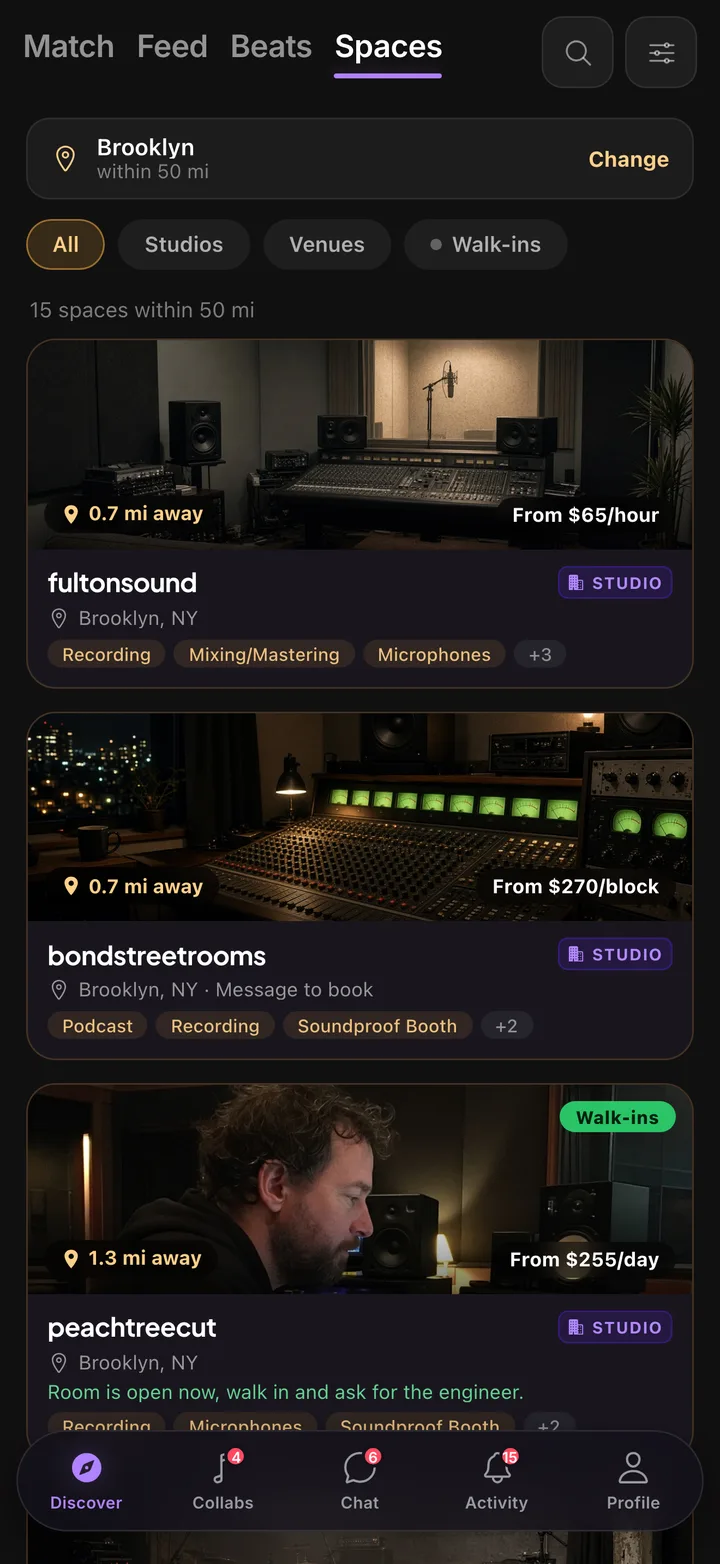
Local is a 50-mile radius around your location. The Feed filter and the Spaces search both start there, and the Match deck ranks by distance without fencing you in. When the room or the person you need is further out, widen Spaces to 100 or 250 miles or sort the deck by Best fit instead of Nearest.
What to look for here
- Producers within 30 miles who list drill, house, footwork or alt-R&B and work overnight sessions
- Drummers, bassists and horn players around Logan Square, Uptown or Bridgeport who play jazz, gospel and indie
- Videographers and photographers in Chicago with festival pit credentials and recap edits on the reel
- Singers and songwriters near Pilsen, Wicker Park or Lincoln Square who split bills and co-write
Studios and venues are found in Spaces and receive requests; they are never in the swipe deck. The rate and the terms get agreed in the app and settle between the two of you. KollabMe never holds the money.
Other cities.
Find the people near you.
Free to join. Setting up a profile takes about a minute.