
City guides Atlanta, GA
Atlanta · scene guideAtlanta for collaborators.
Atlanta runs on pull-up culture. Beats, verses, engineers and shooters move hand to hand through studio lobbies and club nights, and a name travels faster than any tape. Where you work matters: the rap and R&B economy sits on the Westside and in the suburbs, the band and songwriter scene sits east, and the two rarely overlap unless somebody drives.
Where the work happens.
- 01
West Midtown and the Westside
The trap economy is headquartered here. Quality Control built its studio-and-office compound on the west side, the Trap Music Museum sits nearby, and dozens of hourly project rooms cluster among the West Midtown warehouses. Nights run late, and plenty of placements start with a producer in a lobby waiting for a session to open up.
- 02
East Atlanta Village and Little Five Points
The band scene lives on Flat Shoals Avenue, where The EARL books the touring acts that matter and 529 handles the punk-adjacent locals a block away. Little Five Points holds the loud end at Star Community Bar on Moreland, and the same drummers, sound techs and shooters work all three rooms.
- 03
Decatur
Eddie's Attic is the metro's songwriter proving ground, with a Monday open mic that has run for decades and remains the fastest audition in town. Oakhurst Porchfest turns the neighborhood into a free all-day crawl every October. If you write songs with a guitar in Atlanta, this is where you find your co-writers.
- 04
Castleberry Hill and Downtown
Castleberry Hill's lofts are a standing set for video shoots and rollout content, and Means Street Studios keeps a cyclorama room in-house. Downtown is the booking ladder: The Masquerade sorts touring and local acts across its rooms at Underground Atlanta, and State Farm Arena is where the biggest hometown bills land.
- 05
Buford Highway, Doraville and Norcross
The Latin scene runs along Buford Highway, anchored by Plaza Fiesta and La Raza 102.3, with regional Mexican bands and reggaeton DJs working Doraville and Gwinnett more than intown. Up the road in Norcross, Tree Sound runs three main rooms plus smaller suites and pulls clients from every genre in the city.
Rooms
Where it gets recordedThe top tier is Tree Sound in Norcross, Stankonia and the label compounds on the Westside, booked through managers and A&R, engineer included and overnight-heavy. The middle is a dense run of hourly project rooms across West Midtown that sell their late blocks first and confirm same-day by text. Under that is a suburban layer of home studios from College Park to Lithia Springs that book by referral: an engineer passes your name to a producer, the producer opens his room, and the session is on that night.
Nights
Where collaborators meetRap and R&B collaborators meet in studio lobbies and at the club, where a Magic City DJ run after midnight is still the co-sign that matters and Streetz 94.5 breaks the record after. ONE Musicfest weekend in October pulls every A&R and shooter in the city out at once. For players, the church circuit and the blues set at Northside Tavern do the hiring, and Eddie's Attic Monday open mic is where songwriters find each other. Bands trade contacts at The EARL, 529 and Smith's Olde Bar, house heads meet at House in the Park over Labor Day weekend, and City Winery covers the grown-folks R&B weeknights.
How it books
Sessions, features, shoots, showsA session gets booked by text, often the same day, and the serious rooms sell their 10pm-to-6am slots first. Features move hand to hand: an engineer or A&R passes a beat or a hook along, and the verse gets cut in the same building. Shoots get booked around single rollouts, behind-the-scenes retainers and recap edits clubs expect by Monday morning, with Castleberry Hill lofts and the Means Street cyc as standard sets. Shows follow the Masquerade ladder up to Terminal West and Variety Playhouse, and talent buyers answer to hard ticket counts from your last local show.
What Atlanta is known for.
Hip-hop
Hip-hop's center of gravity hasn't moved. Quality Control still breaks stars from its home base, OutKast's Stankonia Studios stays booked, and a single isn't truly broken until Magic City's DJs run it after midnight. The Trap Music Museum on the Westside enshrined the sound's first two decades; Zone 6 and the rest of the east side keep supplying the next one.
How Hip-hop collabs get madeR&B
LVRN rewired the city's R&B when it took Summer Walker and 6lack from local phenomena to global names, and its blueprint shaped the current class of singers. ONE Musicfest stacks its October bill with the genre's headliners; City Winery at Ponce City Market covers the grown-folks weeknight sets. The through line is melody riding trap drums, production DNA other cities can't fake.
How R&B collabs get madePop
Pop out of Atlanta arrives sideways. Lil Nas X rode from Lithia Springs to a 19-week number one that held the Hot 100 record for six years, all with no industry co-sign, and that's still the model: internet-native, hook-first, cut by the same producers who make the city's rap and R&B. Arena pop routes through State Farm Arena and the Coca-Cola Roxy; the homegrown kind gets built in writer-producer sessions.
How Pop collabs get madeCountry
Nobody confuses Atlanta with Nashville, and the scene doesn't pretend otherwise. Georgia grows the stars, Megan Moroney out of Douglasville, Zac Brown Band formed here, and Tennessee signs them. What stays put lives outside the perimeter: Eddie Owen books the songwriter circuit into Red Clay Music Foundry, his 260-seat room in downtown Duluth, while the honky-tonk cover-band economy holds down the exurbs.
How Country collabs get madeIndie
East Atlanta Village is still the load-bearing neighborhood: The EARL books the touring acts that matter, 529 handles the punk-adjacent locals, and both sit a block apart on Flat Shoals. Faye Webster proved an Atlanta indie act can go global, symphony halls, festival bills worldwide, without decamping to Brooklyn; Lunar Vacation ran the same stay-home playbook. The scene stays small enough that everyone shares bills, gear, and drummers.
Electronic
Grant Park turns into the city's dance floor every Labor Day weekend, when House in the Park, the daytime festival Kai Alcé co-founded in 2005, draws thousands of house heads, and his NDATL label still presses Atlanta's deepest house records. At the big-room end, District runs touring EDM headliners through a warehouse-scale rig. Between those poles, DIY crews float techno nights through whatever spaces will have them.
How Electronic collabs get madeRock
The loud end never left Little Five Points, Star Community Bar has run garage and punk bills on Moreland Avenue since 1991. The Masquerade sorts touring rock across its four rooms at Underground Atlanta, Smith's Olde Bar keeps the club circuit honest, and the heavyweight lineage stretches from Mastodon to Manchester Orchestra. No hype cycle here, just steady rooms and bands that tour hard.
Jazz
Memorial Day weekend belongs to the Atlanta Jazz Festival, which has filled Piedmont Park for free since 1978 and remains one of the largest events of its kind in the country. The rest of the year works small: The Velvet Note, a 40-seat listening room up in Alpharetta, books national names into a space quieter than most studios, and the city's players stay busy crossing into gospel, hip-hop, and neo-soul sessions.
Latin
Buford Highway is the spine. Plaza Fiesta's mercado of 140-plus vendors has anchored Latin Atlanta since 2000, and La Raza 102.3 keeps the corridor's car stereos on regional Mexican, the sound now selling arena-scale dates across the metro. The geography is suburban, Doraville and Gwinnett County more than Midtown, and reggaeton nights rotate through intown clubs rather than owning a dedicated room.
How Latin collabs get madeFolk
Decatur carries the tradition. Eddie's Attic has run its open mic for three decades, John Mayer and Shawn Mullins both came through that room on the way up, and it still functions as the metro's songwriter proving ground. Every October, Oakhurst Porchfest turns about 200 front porches into stages for a free all-day crawl. The Indigo Girls' hometown pull never really faded.
How the app works in Atlanta.
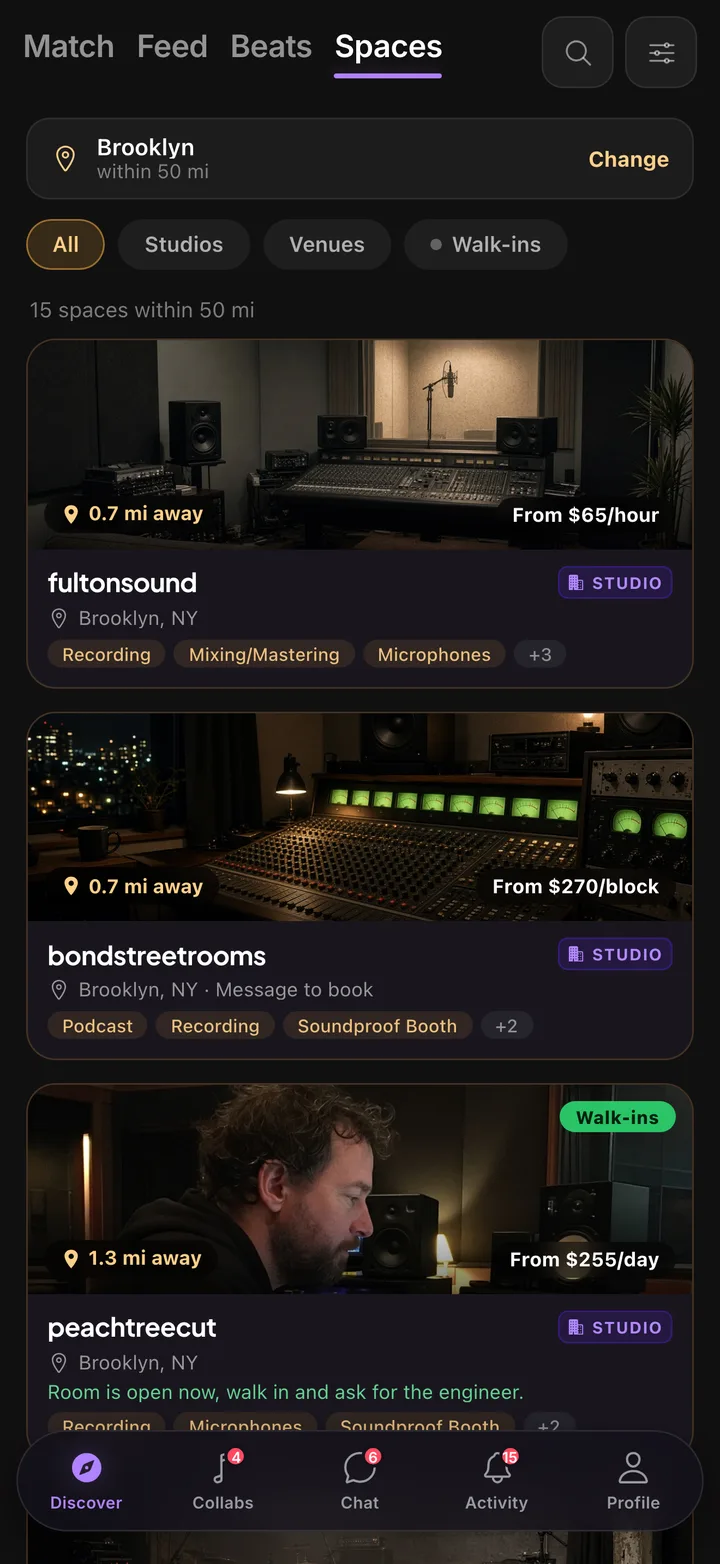
Local is a 50-mile radius around your location. The Feed filter and the Spaces search both start there, and the Match deck ranks by distance without fencing you in. When the room or the person you need is further out, widen Spaces to 100 or 250 miles or sort the deck by Best fit instead of Nearest.
What to look for here
- Producers within 40 miles who list trap, R&B or melodic rap and record out of a Westside or suburban home studio
- Engineers and mix engineers near West Midtown available for overnight blocks
- Videographers and photographers in Atlanta with rollout, loft and recap work on the reel
- Drummers, keys and guitarists around East Atlanta or Decatur who play church, blues and indie bills
Studios and venues are found in Spaces and receive requests; they are never in the swipe deck. The rate and the terms get agreed in the app and settle between the two of you. KollabMe never holds the money.
Other cities.
Find the people near you.
Free to join. Setting up a profile takes about a minute.